

- Integrated sewag...
- Dental clinic se...
- Laboratory sewag...
- Waste gas treatm...
Laboratory sewage treatment equipment
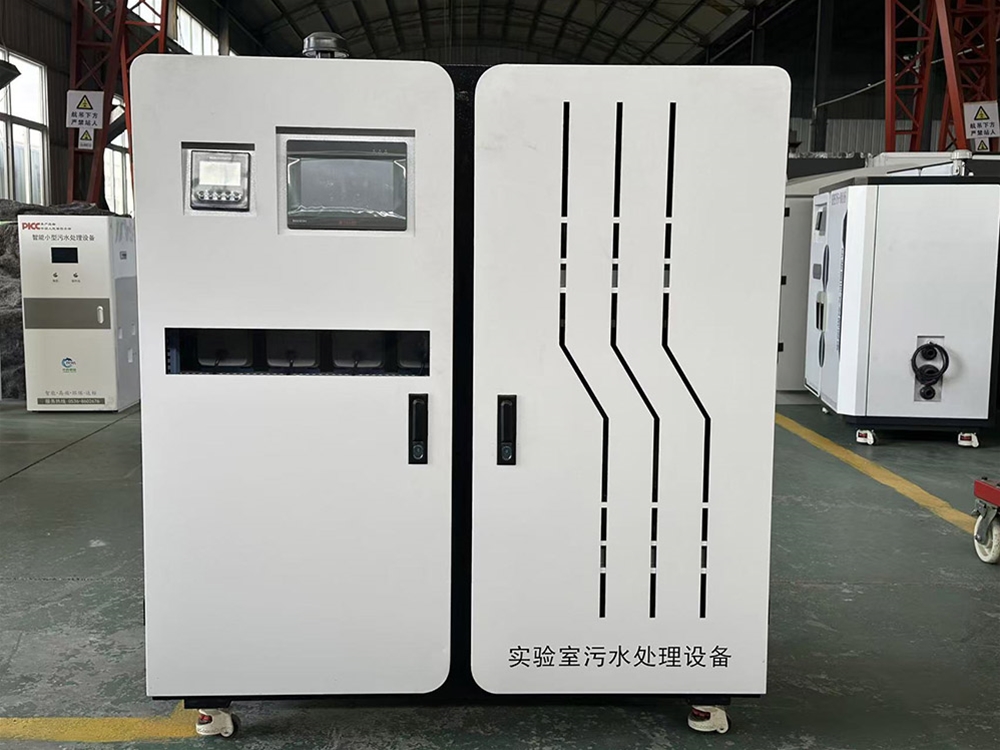
Details
1. Overview
The wastewater treated in this project is laboratory wastewater, which contains inorganic pollutants, organic pollutants, microbial pollutants, etc. There are mainly pollutants such as acids, bases, soluble salts, hydrocarbons, ketones, ethers, phenols, aldehydes, bacteria, viruses, etc.
The designed wastewater treatment capacity for this project is 1T/D
The main pollution factors are:
1) Inorganic pollutants: pH values, halide ions, and other non-metallic ions, etc; a、 Heavy metal ions: metal cations such as mercury, cadmium, chromium, lead, manganese, silver, nickel, zinc, copper, aluminum, arsenic, as well as complex heavy metal ion groups (Cr2O7) 2-, (CuCN) -, (AuCN) -, (Ptcl6) 2-, etc; b、 Acidic and alkaline pH values: ammonia water, nitric acid, hydrochloric acid, sulfuric acid, hydrogen peroxide, potassium chloride, calcium chloride, etc.
2) Organic wastewater: organic solvents, oily substances, sugars, proteins, polycyclic aromatic hydrocarbons, ethanol, halogenated hydrocarbons, toluene, phenol, alkanes, alkenes, ketones, ethers, phenols, aldehydes, organic phosphorus, etc.
3) Microbial wastewater: bacteria, viruses, etc
2. Basic situation of sewage
2.1 Source of sewage
The main sewage is laboratory sewage, which is pre treated by newly added integrated sewage treatment facilities and discharged into septic tanks after reaching the standard. It is then discharged into XX sewage treatment plant for treatment along with domestic sewage through the municipal sewage pipeline network. The sewage treated in this project is comprehensive medical sewage, which usually contains inorganic pollutants such as sulfuric acid, nitric acid, hydrochloric acid, isoacids, alkalis, salts and caustic soda, heavy metal ions such as chromium, zinc, manganese, copper, iron, etc; Organic pollutants mainly include hydrocarbons such as alkanes, alkenes, ketones, ethers, phenols, aldehydes, etc; Biological pollutants mainly contain pathogenic microorganisms such as bacteria and viruses.
2.2 Sewage volume
According to the Environmental Impact Assessment Report of the XXX Center for Disease Control and Prevention Laboratory Construction Project, high concentration waste liquids such as drugs, reagents, test solutions, waste liquids, and residual reagents in the laboratory can be collected and outsourced for hazardous waste disposal. Comprehensive sewage such as container washing and instrument cleaning can be discharged into the sewage pipeline. The sewage discharge capacity of the project laboratory is 20m3/d.
2.3 Sewage discharge standards:
The laboratory sewage is treated by the sewage treatment station and discharged into the sewage pipe network for treatment at the XXX sewage treatment plant. According to the GB18466-2005 "Discharge Standards for Water Pollutants in Medical Institutions" of the People's Republic of China, the following:
Table 2-1 "Discharge Standards for Water Pollutants in Medical Institutions" Table 2 Pre treatment Standards Unit: mg/L, pH dimensionless
Project COD BOD5 Ammonia nitrogen; SS pH Total residual chlorine; Fecal coliforms count
Concentration (mg/L); 250 100 - 60 6.5-9 2~8 5000 MPN/L
The design inlet standards for XXX sewage treatment plant are as follows:
Combining two standards, the discharge standard for laboratory wastewater after treatment at the sewage station is determined as follows:
Table 2-2 Emission Standards for This Project Unit: mg/L, pH Non dimensional
Project COD BOD5 Ammonia nitrogen; SS pH Total residual chlorine; Fecal coliforms count
Concentration (mg/L); 250 100 25 60 6.5~9 2~8 5000 MPN/L
3. Design Basis
3.1 Environmental impact assessment and related materials provided by the Center for Disease Control and Prevention
3.2 Current National Design Specifications and Standards
(1) Discharge Standards for Water Pollutants in Medical Institutions (GB18466-2005)
(2) Technical Specification for Hospital Wastewater Treatment Engineering (HJ2029-2013)
(3) Water Quality Standards for Sewage Discharged into Urban Sewers (GB/T31962-2015)
(4) Environmental Engineering Handbook (Water Pollution Prevention and Control Volume)
(5) Design Standard for Outdoor Drainage (GB50014-2021)
(6) Design Code for Pipeline Structure of Water Supply and Drainage Engineering (GB50332-2002)
(7) Code for Design of Low Voltage Distribution Equipment and Lines (GB50054-2011)
(8) Code for Construction and Quality Acceptance of Automation Instrumentation Engineering (GB50093-2013)
3.3 Relevant laws, regulations, documents, and provisions of the country and region.
4. Design principles
4.1 Strictly abide by national and regional environmental regulations, and conscientiously implement relevant technical specifications.
4.2 The treatment process should be mature, advanced, and operate stably, with high treatment efficiency and strong resistance to impact loads. After treatment, the effluent quality should be stable and meet the discharge standards.
4.3 This project should be based on scientific, comprehensive, and unified principles. Taking into account the current situation of the hospital, it is necessary to leave sufficient capacity for future development.
4.4 Taking into account the actual situation and objective conditions, while meeting emission standards and process requirements, fully utilize the utilization rate of each part, save investment, and reduce operating costs.
4.5 High degree of process automation operation, convenient operation and management, and easy maintenance.
4.6 The overall layout of the project should be coordinated with the surrounding environment.
5. Design content and scope
5.1 The entire content of the process, equipment, electrical, and self-control of the sewage treatment system.
(1) Process design: The process design of this plan includes the process design, equipment manufacturing, installation and commissioning of sewage treatment equipment from the sewage inlet to the sewage standard discharge outlet, but does not include the design of the grid sewage collection and discharge pipeline network. The sewage is directly connected to the equipment by the user, and the drainage pipe is connected to the final standard effluent outlet of the treatment station as the handover point.
(2) Electrical design: The connection of various equipment and appliances on site, including automatic control and monitoring of the equipment, with the sewage treatment equipment electrical control cabinet as the handover point. Party A is responsible for connecting the three-phase power supply to the on-site central control distribution cabinet.
6. Design processing capacity and standards
6.1 Design processing capacity:
The designed processing capacity of this project is 20m3/d, with an annual laboratory working time of 250 days, 1 shift per day, and 8 hours per shift. The sewage treatment facilities operate 24 hours a day, with an hourly processing capacity of 1.2m3/h.
6.2 Design Standards:
To meet the pre-treatment standards in Table 2 of the National Standard of the People's Republic of China for the Discharge of Water Pollutants from Medical Institutions (GB18466-2005), and to meet the inlet standards for XXX sewage treatment plant into the municipal sewage pipeline network, the project meets the discharge standards (Table 2-2).
7. Sewage treatment process design
7.1 Processing technology
This plan is designed for the treatment of comprehensive laboratory wastewater, which is characterized by large organic molecules and high levels of inorganic acids, bases, and plasmas. It is not suitable to directly use biochemical treatment and must undergo pre-treatment and oxidation decomposition treatment.
Based on the characteristics and experimental results of this type of wastewater, this project intends to adopt the method of "; Pre treatment physical and chemical oxidation+deep treatment process; This processing method can achieve good processing results.
CONTACT US
Weifang Kehang Environmental Protection Technology Co., Ltd
Headquarters Address: No. 18 Changqing Street, Junbukou Industrial Park, Weicheng District, Weifang City, Shandong Province
Headquarters phone number: 0086 18905367584/13869601795
Service Hotline: 0086-536-2259698/0536-8803882
National complaint hotline: 400-9700918

Scan to follow WeChat official account